
The OECD’s 2025 statistics on the Mutual Agreement Procedure (MAP) paint a cautiously positive picture. Globally, more cases were closed, average resolution times declined and the overall number of pending MAP cases decreased slightly. However, this progress was driven almost entirely by non-transfer pricing cases. Transfer pricing remains the primary area of concern: the inflow of new cases remains high, the number of pending transfer pricing cases continues to grow, and these cases generally take longer to resolve.
The total number of pending MAP cases decreased slightly to 6,113 (6,161 in 2024), largely due to a decline in non-transfer pricing cases. Transfer pricing followed the opposite trajectory, with pending cases rising to 3,209 (3,143 in 2024). Meanwhile, overall average resolution times fell to around 26 months (27 month in 2024), whereas transfer pricing cases still took more than 30 months on average.
These longer resolution times do not, however, translate into less favourable outcomes. On the contrary, over 80% of transfer pricing cases closed in 2025 resulted in full resolution, a higher proportion than for other MAP cases. The core challenge for transfer pricing therefore lies not in the outcome of the procedure, but in the steady inflow of new cases and the time required to close them.
A similar pattern emerges for Advance Pricing Agreements (APAs). Although more APAs were granted, new applications continued to outpace the number of cases closed. Consequently, the number of pending APA cases increased further, while average processing times remained high at approximately 40 months.
Belgium also recorded a decline in its overall number of pending MAP cases, with the decrease being more pronounced than at the global level. As with the global figures, this decline was driven by non- transfer pricing cases, while the number of pending transfer pricing cases increased slightly.
Belgium also compares favourably on resolution times. The average resolution time for post-2015 cases was approximately 21 months. Transfer pricing cases took around 27 months on average, below the global average of more than 30 months, though still above the 24-month target.
Belgium’s pending MAP cases are also relatively recent, and nearly 88% of transfer pricing cases closed in 2025 achieved full resolution, underscoring Belgium’s strong performance in terms of MAP outcomes.
While a large proportion of Belgium’s pending cases involve Western European countries, a significant number of new procedures involving Poland, Singapore and the United States were initiated in 2025.
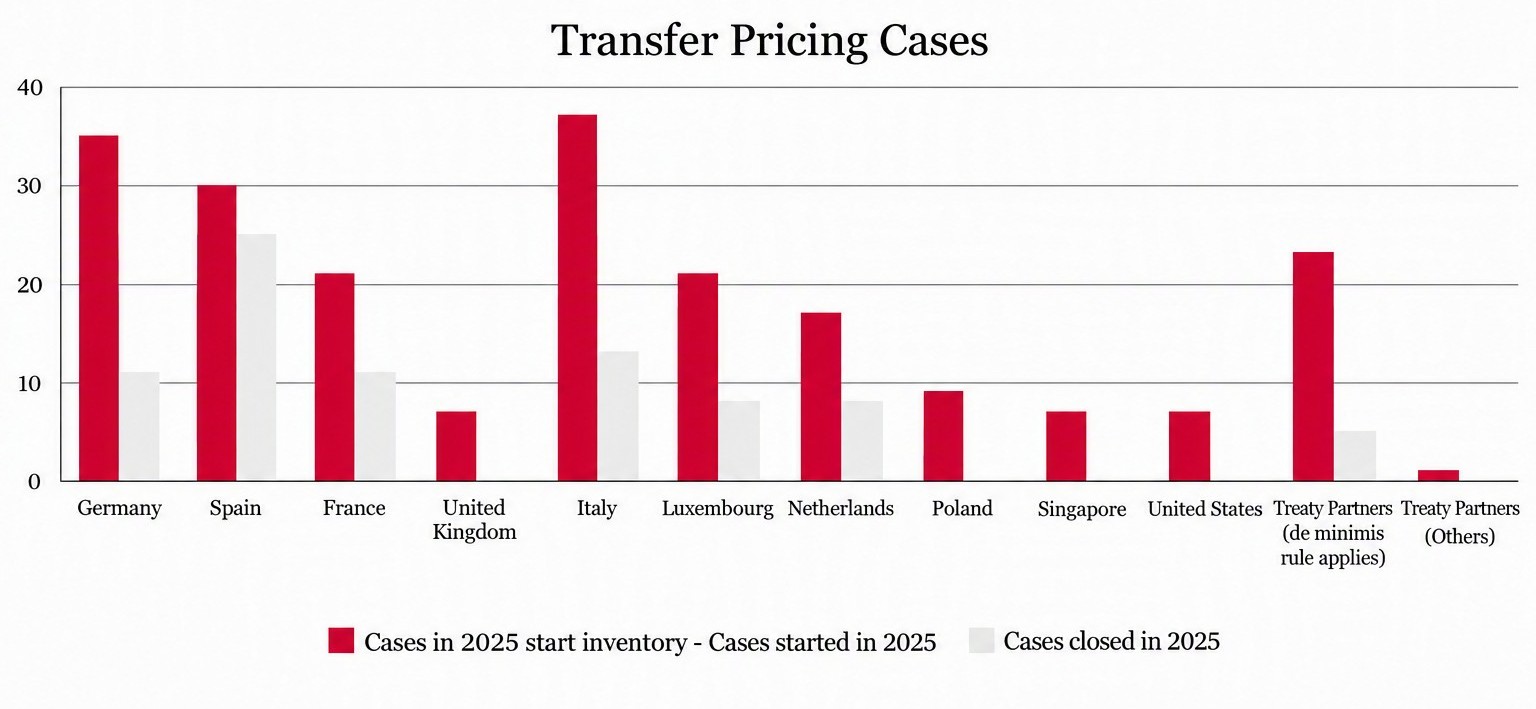
Overall, the picture remains mixed. Belgium performs better than the global average across several MAP indicators, yet transfer pricing continues to be a persistent challenge. The high proportion of cases reaching full resolution is encouraging. However, the continued inflow of new disputes, the growing number of pending transfer pricing cases and longer resolution times continue to prevent a meaningful reduction in the number of outstanding transfer pricing cases.
Companies navigating cross-border transfer pricing disputes should therefore continue to anticipate lengthy procedures, even though the likelihood of reaching a full resolution remains high.
If you have any questions about these developments or their implications for your business, please contact Kenny or Tine