
Ongoing conflicts and geopolitical tensions in Ukraine and the Middle East have contributed to volatility in oil and gas prices and to higher inflation expectations. Against this backdrop, financial markets have increasingly priced in a higher interest-rate environment. In June 2026, the ECB raised its three key interest rates by 25 basis points. While the ECB has emphasized that future monetary policy decisions will remain data-dependent and will be taken on a meeting-by-meeting basis, financial markets are currently anticipating a further increase of 25 basis points in the ECB rates in September.
As illustrated in the graph below of the EUR BBB 5-year corporate yield curve (source: S&P Capital IQ, as of September 2026), these developments have already been reflected in an upward trend in market interest rates, resulting in higher borrowing costs across financial markets.
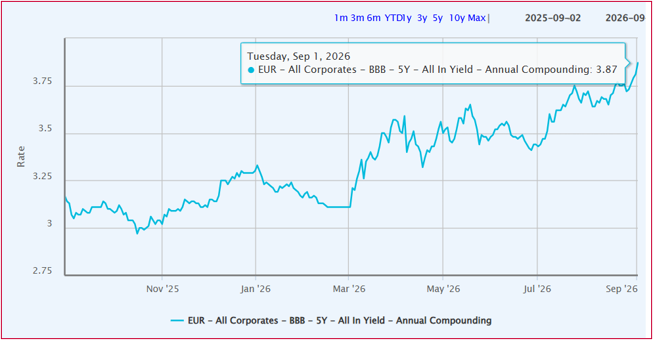
Source: S&P Capital IQ
As the overarching principle of transfer pricing (“TP”), the arm’s length principle requires that controlled transactions between related parties should reflect the terms and conditions that independent parties would have agreed upon under comparable circumstances in an open market context. Accordingly, changes in external market conditions – such as rising interest rates – may significantly affect (existing and new) intercompany financial transactions and should therefore remain closely monitored and on taxpayers’ radar from a TP perspective.
Furthermore, as tax authorities increasingly focus on financial transactions, reviewing and documenting the arm’s length nature of intercompany interest rates should be high on the tax manager’s agenda.
This article outlines the key TP implications arising from the current higher interest rate environment for intercompany financial transactions. In addition, we briefly address the impact that rising market interest rates may have on business valuations.
As a general rule, intercompany loans are priced at the time of issuance by reference to the prevailing market rates at that time and taking into account the specific characteristics of the intercompany loan (currency, maturity, rank, etc.) and the creditworthiness of the borrower. As such, a rise in interest rates does not automatically imply that the original (fixed) interest rate is no longer arm’s length.
That said, in a third-party context, an independent lender may be expected to reassess or renegotiate financing terms in the event of sustained changes in market conditions, with a view to reallocating funds towards higher-yielding opportunities, taking into account the options realistically available to the lender. This becomes particularly relevant where the intercompany loan is repayable on demand at the option of the lender (see below).
For new (or renewed/materially amended) intercompany loans, it is essential that the pricing reflects the most recent market data available at the time of issuance, by reference to appropriate market references. In this respect, TP treasury policies that price new intercompany loans based on (outdated) standardized interest rates, or that are extended or renewed without considering the updated market circumstances, may become misaligned with prevailing market conditions and could therefore be challenged by tax authorities on the basis that they deviate from the arm’s length principle. In any case, the business rationale for renewing or materially amending an intercompany loan should be reflected in the updated terms and conditions as well as properly documented. The documentation should explain how the business rationale and the parties’ realistically available options support the revised terms and pricing.
Against this background, it becomes increasingly important for taxpayers to review and, where necessary, update their TP treasury policies to ensure they remain robust, up to date, and aligned with current market conditions in view of the arm’s length principle, while maintaining contemporaneous and robust TP documentation to mitigate future controversy risks[1]. Indeed, a TP treasury policy that takes into account the relevant market circumstances when issuing an intercompany loan helps ensure that the arm’s length nature of the loan can be robustly supported and defended in the event of questions from tax authorities.
In periods of stable interest rates, the value of a borrower’s option to prepay a loan early tends to be relatively low, as there are limited opportunities to refinance at more favourable rates. Although such premiums will generally remain relatively limited in a rising interest rate environment (as a borrower will likely have less incentive to refinance the loan), increased market volatility may warrant a closer assessment of the pricing of option features included in intercompany loans. In this context, it is relevant to consider whether a borrower would be willing to pay a premium for the flexibility to prepay the loan without incurring a penalty.
On the other hand, for loan agreements that grant the lender an early demand option, it may also be necessary to consider whether an independent third-party lender would seek to renegotiate the loan terms in order to obtain a higher interest rate. Accordingly, intercompany loan agreements should be reviewed to identify whether such clauses are included.
For both cases, i.e., early prepayment option or early demand option, maintaining a concise contemporaneous track record of why an option was not exercised can be valuable, particularly because tax authorities may question why such options were included in the loan agreement.
Where financing companies (or in-house banks) are funded through variable-rate debt instruments[2], but lend funds to affiliated entities under fixed interest rates, rising interest rates may significantly increase the financing company’s interest expenses whilst its interest income remains stable. This can result in reduced margins or even losses, and may therefore be scrutinized from a TP perspective. Whilst the interest rates on those intercompany loans may be in line with the arm’s length perspective, as the fixed interest rates are set at the start of the intercompany loans, tax authorities may raise questions on the interest rate applied on the intercompany loans (from the perspective of the country where the financing companies are located), and may also request information about the external funding arrangements. Again, the business rationale should be the principal driver of the terms and conditions of the intercompany loan agreement.
Particularly in cases where financing companies attract external funding to fund a specific project or company but the conditions (e.g., variable versus fixed interest rate) differ between the external and internal funding, the business rationale should explain such deviations.
Specifically, Luxembourg companies engaged in intermediary financing (“back-to-back”) activities should earn an arm’s length remuneration and maintain an adequate equity level, in line with the Luxembourg TP Circular. In a rising interest rate environment, the Luxembourg tax authorities may scrutinize whether the on-lending margin remains arm’s length and the equity level remains appropriate, in view of the functional risk profile of the Luxembourg entity.
Moreover, during periods of economic slowdown or heightened market volatility, it becomes increasingly important to identify which entity within a group assumes and manages financial risks in practice (such as interest rate and FX risks, which may be managed through hedging arrangements). In this context, corporate groups should ensure proper documentation of which entity manages these risks and that the remuneration of treasury activities under TP policies is consistent with the entity’s functional and risk profile.
In a rising interest rate environment, parental or intra-group guarantees may become increasingly important – or even necessary – to obtain external financing, or to secure it at a lower interest rate. Accordingly, the economic benefit of an explicit guarantee may increase where it improves access to funding or reduces the borrower’s credit spread. This should be assessed on the basis of the borrower’s position with and without the guarantee, rather than interest-rate movements in isolation. As a result, the arm’s length pricing of guarantee fees will likely become more relevant from a TP perspective. Again, while a fixed interest rate applied may be in line with the arm’s length principle, and the financial guarantee analyzed to be zero at the start of the loan, materially amending the loan might affect not only the interest rate applied under the loan transaction, but also the remuneration in view of the guarantee provided. Given that this previous guarantee transaction occurred without compensation, it is important to be aware of the financial relationship between the parties involved and analyze the arm’s length compensation of such guarantee.
At the same time, taxpayers should carefully assess whether a group company effectively assumes credit risk by providing an intra-group guarantee or similar support, and ensure that such guarantee is remunerated on an arm’s length basis. The absence of a default of the borrower in the past does not, in itself, imply that no compensation is or was warranted.
Furthermore, while tax authorities in the past focused on the interest rate applied, and the guarantee fee analysis basically depended on the interest rate differential between the loan provided to the borrower with and without the explicit guarantee (but taking into account the effect of implicit group support), tax authorities focus more on business rationale of financial transactions. Therefore, it might be recommended to also consider alternative guarantee fee methodologies. Indeed, as the guarantee does not necessarily provide an impact on the interest rate applied, it could have an effect on the principal amount. The yield approach, i.e., the analysis on the interest rate differential, concludes in such case on a zero compensation, while particularly in rising interest rate environments, the potential cost the guarantor can expect to incur increases.
In general, a debt capacity analysis assesses a borrower’s ability to incur and service debt, typically by reference to financial ratios such as interest coverage ratios (EBIT or EBITDA-to-interest expense). In a rising interest rate environment, increasing financing costs may significantly reduce the borrower’s debt-servicing capacity and, consequently, the amount of debt that could realistically be sustained under arm’s length conditions.
Importantly, even where the borrower’s debt capacity may have been sufficient at the time of debt inception, subsequent higher interest rates may materially alter its ability to service existing debt, especially where variable interest rates apply. In such circumstances, a parental guarantee may become more necessary to ensure ongoing debt servicing, thereby reinforcing the importance of the arm’s length nature of the guarantee fee.
Moreover, as rising interest rates generally make debt financing less attractive relative to equity funding, this may also be reflected in the debt-to-equity ratios observed in independent companies going forward. In turn, this may affect the level of leverage that may be considered arm’s length for a borrower within a group in light of its capital structure.
In this view, tax authorities may increasingly scrutinize whether a borrower has the capacity to service intercompany debt and, whether the amount and terms of the intercompany funding are consistent with debt that an independent lender would have provided. This may ultimately lead to challenges regarding the deductibility of intercompany interest expenses where the level of leverage is deemed excessive or not supported by a TP analysis. Particular attention should also be given to whether the loan amount can be justified by a clear economic rationale, for example by being directly linked to identifiable funding needs such as investments in buildings, machinery, etc.
Moreover, and similarly, rising interest rates may also indirectly impact the creditworthiness of a borrower. Weaker interest coverage ratios can translate into a higher perceived credit risk profile, which in turn may lead to the application of higher arm’s length interest rates going forward, thereby further reinforcing the pressure on the borrower’s credit profile. Refinancing current debt instruments may be an option to improve the borrower’s ability to service debt and potentially mitigate its credit-risk profile, but should be analyzed in terms of principal amount outstanding and current versus new interest rate applicable on such refinanced debt instruments.
Hence, when contemplating new intercompany financing, it is increasingly important to assess the borrower’s debt capacity and creditworthiness, based on a robust analysis and to document this properly. In this context, consistency in the approach used to determine debt capacity and credit rating is important, particularly given that the OECD Guidelines are not always fully clear in this respect, for example with respect to the extent to which group credit ratings should be applied versus standalone ratings that may incorporate implicit group support.
Additionally, various (local) deductibility aspects (EBITDA limitations, thin cap, etc.) may become even more relevant in view of increasing interest rates. Particularly when the capacity to bear certain debt levels is changing due to the higher interest rate environment. This may especially be so considering that some companies, even in the low interest rate environment of the past were already facing the deductibility limitations. Companies or industries may also be impacted by other aspects that are relevant for the computations of such rules, which may increase deductibility limitations. For example, if the EBIT(DA) of a company would decrease, combined with increased interest rates, there will be a higher impact compared to if only one parameter would change.
The short-term interest rate environment can probably better be identified as volatile, rather than increasing long-term interest rate environment (as the long-term interest rate is impacted by the market’s expectations and confidence, the short-term interest rate is rather impacted by current macro-economic factors (volatile due to the geopolitical tensions) and dynamics on the money market). Therefore, the effect on current accounts and cash pool arrangements (please refer to this article in view of the difference between those arrangements), is rather volatile as well.
However, given the trend of tax authorities attempting to reclassify short-term positions into long-term structural positions, the potential tax risk increases with increases of the long-term interest rate. There are many arguments to bring against such straight reclassifications which are mostly not at arm’s length. However, the risk attached to the reclassification of short-term positions (bearing short-term rates) into longer-term positions (bearing higher long-term rates) will increase. A frequent assessment of short-term positions is therefore recommended.
Beyond intercompany financial transactions, rising interest rates may also significantly affect business valuations. Higher interest rates generally increase the cost of debt and, in turn, the weighted average cost of capital (WACC), which is typically used as the discount rate in view of the discounted cash flow method (DCF) – the effect on the cost of equity is less direct (while the risk-free interest rate increases, changes in the market risk premium may offset or amplify the effect of a higher risk-free rate depending on beta and capital structure[3]).
As discount rates increase, the present value of expected future cash flows decreases, typically resulting in lower enterprise valuations. In this context, highly leveraged companies and sectors, as well as those characterised by low current cash flows relative to high expected future cash flows (i.e., relying strongly on future growth), are likely to be most affected. The effect will depend on the company’s debt repricing profile, capital structure, cash-flow duration and the movement in each component of the discount rate.
Accordingly, companies should carefully consider the timing of (intra-group) asset transfers, as the resulting value may have tax implications, and they should also ensure that discount rates are updated to reflect rising market interest rates. In particular, where a loan (portfolio) is transferred from one group entity to another, such transfer should be carried out at fair market value, based on the price that would be agreed between a willing buyer and a willing seller in an arm’s length transaction. In a rising interest rate environment, the fair value of loans receivable typically decreases (as also observed in lower prices of previously issued bonds in the market), as higher discount rates (linked with the higher interest rate environment) reduce the present value of expected future interest cash flows.
Furthermore, although the interest rate environment provides downward pressure on the valuation of companies or assets, the funding via debt is getting more expensive. As discussed above, an appropriate capital structure differs now compared to the low interest rate environment of a couple of years ago, with the debt capacity shrinking due to the higher interest rates to be paid.
Business plans considering expected cash flows based on current market conditions could help companies avoid unpleasant surprises over an M&A trajectory. Likewise, in an organic growth strategy, planning or forecasting cash flows helps to better plan the investment requirements and helps fine-tuning financing requirements – even more relevant in an increasing interest rate environment.
To conclude with an example, the general software companies industry already feels the downward pressure on their valuations (with the increasing interest rate environment one of the factors), as shown by the yield of the iShares Expanded Tech-Software Sector ETF as per 31/07/2026, which was only 0.02% compared to the 10-year annualized yield of approximately 15%. This does not mean, however, that particular companies cannot go against a certain trend.
If you have any questions on these topics or would like to discuss the content of this publication, please feel free to contact us.
Authors: Vincent Junius, Kenny Van Tulder & Jacques Otten
_______________
[1] Please note that as from FY2025 the Belgian master file requires a more detailed description of the multinational's financing policies and arrangements, requiring to describe the financing mix as well as the intercompany financing instruments applied, which are, then, detailed in the local files. Hence, it is a good time to reconsider your financing mix as well as the financing instruments applied, i.e., your treasury policy, and document it accordingly.
[2] In a variable interest rate debt instrument a fixed margin, which does not change over the tenor of the loan agreement, linked with the borrower’s credit profile, is added to a market reference rate, which is updated in line with interest rate payments. Hence, a significant part of the interest rate risk, i.e., the risk that interest rate rises, is passed on from the lender to the borrower in view of increases or decreases in the market reference rate. Such market reference rate is linked with a risk-free rate and adds specific premiums to account for time, (limited) credit risk and liquidity. The interest rate margin captures the additional credit risk of the specific borrower and is expected to be rather stable if the credit profile of the borrower does not improve or deteriorates over the tenor of the loan. In view of fixed interest rate debt instruments, the interest rate risk exposure remains at the level of the lender.
[3] Indeed, the market risk premium is the premium an investor requires for investing in equities rather than risk-free assets. Thus the market risk premium is calculated as the difference between the required return on equity (which is expected to be rather stable in the long-term) and the risk-free rate